Introduction
Within the vast realm of global textile arts, Persian brocade and European brocade stand out as two luxurious and significant traditions, each with its own history, techniques, applications, and aesthetics. A careful comparison of these two not only deepens our understanding of their unique heritage but also reveals how cultures influenced one another through textile-making and weaving.
This article explores their origins, weaving techniques and materials, motifs and symbolism, cultural and social roles, and finally, their relevance in contemporary design.
Historical Origins
Persian Brocade
- Zarbaft (literally “woven with gold”) refers to textiles in which golden or metal-wrapped threads are integrated into the weave.
- The tradition dates back to pre-Islamic Iran, reaching its peak during the Sassanid era and flourishing again under the Safavid dynasty (16th–17th centuries).
- Royal workshops in Tabriz, Qazvin, and Isfahan centralized the production of silk, dyeing, and luxury weaving under Safavid patronage.
- Surviving Safavid brocades in major museum collections reveal high technical skill, complex compositions, and shimmering metal threads.
European Brocade
- The word Brocade derives from the Italian broccato, rooted in Latin broccus, meaning “embossed” or “ornamented.”
- Decorative fabrics with metallic threads were already known in Byzantium and spread widely through the Mediterranean.
- From the Renaissance onward (14th–18th centuries), Italy (Venice, Florence) and later France became leading centers of brocade production. Many designs were inspired by imported silks and Persian textiles arriving via trade routes.
- One key transformation in Europe was the adoption of advanced looms, eventually leading to the Jacquard loom in the Industrial era, which allowed for more intricate and reproducible designs.
Materials, Techniques, and Weaving Processes
| Feature | Persian Brocade | European Brocade |
| Warp (foundation) | Pure silk or blends with local fibers | Primarily silk, later mixed fibers |
| Decorative weft | Golabetoon (gold/silver-wrapped yarn), natural dyed threads | Metal threads (gold/silver-plated), later chemical dyes |
| Looms | Hand looms, master artisans in court workshops | More advanced looms, eventually Jacquard loom |
Structure and Methods
- Persian brocade relies heavily on supplementary wefts, with gold or silver threads laid into silk grounds, creating shimmering surfaces. Tension, density, and accuracy of the loom determine the quality of motifs.
- European brocades also used supplementary wefts, but their structure evolved with technological advancements and synthetic dyes in the Industrial era.
- In Iran, natural dyeing traditions—such as cochineal reds fixed with alum—remained essential, ensuring long-lasting hues and subtle tonalities.
Motifs, Patterns, and Aesthetics
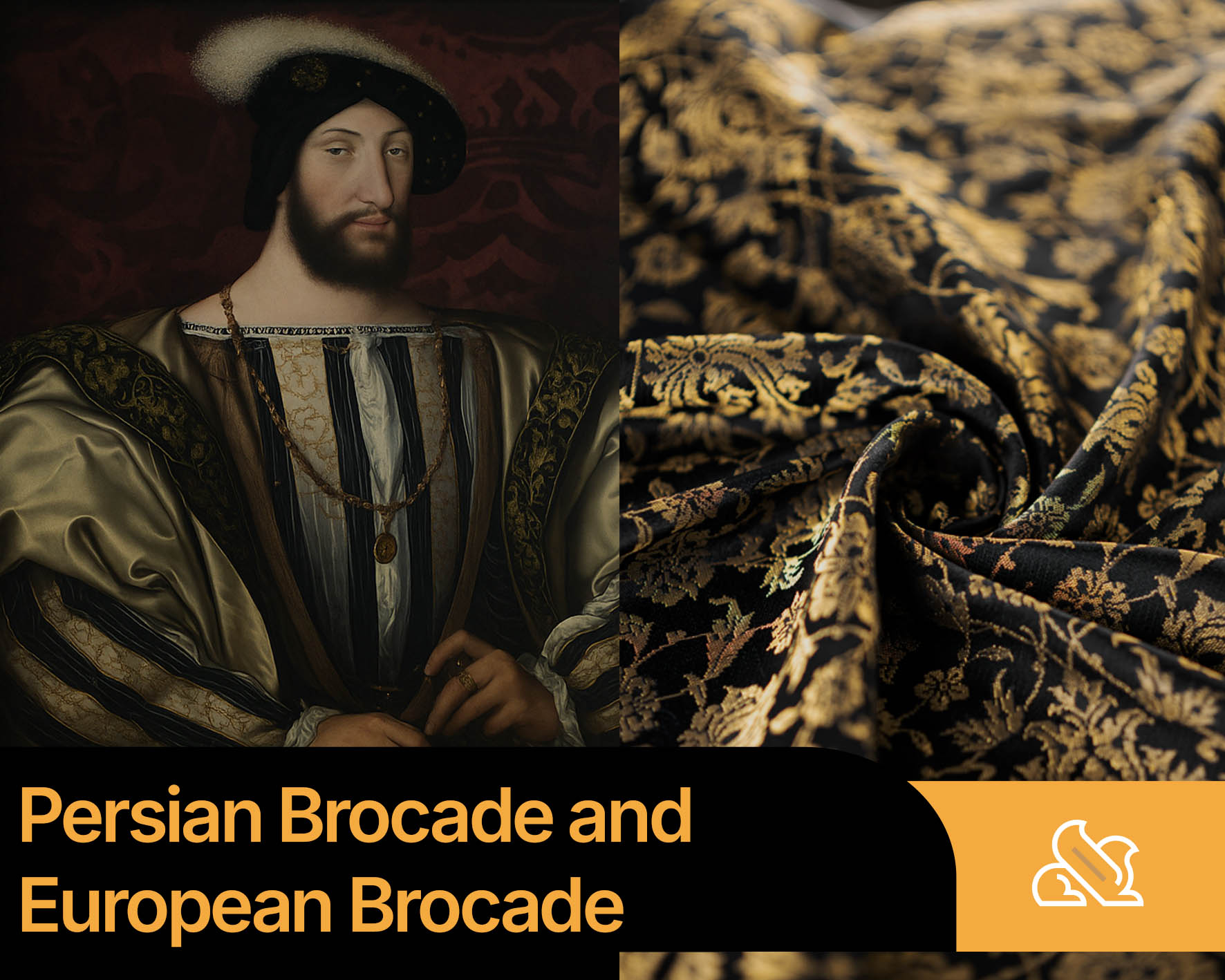
- Persian Brocade: motifs often included boteh (paisley), arabesques, simurgh (mythical bird), floral scrolls, and even literary themes such as Leili & Majnun. Designs were symmetrical, geometric, and combined with the reflective qualities of metal threads.
- European Brocade: strongly influenced by Renaissance, Baroque, and Rococo styles, featuring large floral arrangements, ornamental scrolls, and theatrical patterns.
- Aesthetic difference: Persian brocades used gold subtly to enhance depth and storytelling, while European brocades often emphasized bold, oversized motifs and light-play through metallic sheen.
Cultural and Social Roles
- In Iran, brocade symbolized power, wealth, and legitimacy. It adorned royal garments, palace curtains, and religious textiles. Safavid brocades were also valuable exports, sought by Ottoman and European elites.
- In Europe, brocade was associated with aristocracy and the Church. It was used for ecclesiastical vestments, court attire, and luxurious furnishings, marking social rank and prestige.
Cross-Cultural Influences
- Through the Silk Road and Mediterranean trade, Persian designs deeply influenced European weaving. Renaissance patterns often echoed Persian floral motifs and compositions.
- Conversely, Europe’s adoption of mechanical looms and synthetic dyes in the 18th–19th centuries reshaped global textile markets, creating competition for handcrafted Persian brocades and shifting luxury tastes.
European Brocade Across the Ages
- Medieval & Byzantine period: luxury textiles circulated via Venice and Genoa as hubs between East and West.
- Renaissance & Baroque: opulent brocades flourished in aristocratic fashion and interiors.
- Industrial Revolution: mass production and chemical dyes made brocades more affordable, but at the cost of artisanal refinement.
Persian Brocade in the Contemporary Era
- Surviving workshops in Iran continue traditional weaving, focusing on silk quality, natural dyes, and meticulous craftsmanship.
- Renewed interest in heritage luxury and slow fashion has brought Persian brocade into modern haute couture collections.
- Conservation projects—such as studies of Qajar-era brocade belts—highlight the advanced historical use of composite metallic threads and natural dyes, offering insight into both artistry and material science.
Strengths and Challenges
| Feature | Persian Brocade | European Brocade |
| Strengths | Complex, story-driven motifs; natural dyes; cultural symbolism | Faster production; broader color palettes; international recognition |
| Challenges | High cost, time-consuming, preservation issues | Risk of quality loss in mass production; detachment from artisanal roots |
Conclusion
The comparison between Persian and European brocade reveals two intertwined yet distinct narratives of textile art. Persian brocade, rooted in storytelling and intricate design, represents cultural identity and artistic legacy. European brocade, influenced by Persian imports but expanded through technological innovation, became a hallmark of aristocratic display and decorative luxury.
In today’s global fashion and heritage markets, both traditions hold relevance: Persian brocade as a rare artisanal treasure, and European brocade as a foundation for luxury design history. Together, they remind us that weaving is not only about fabric, but about the threads of culture, identity, and continuity.


