Introduction
The story of textiles is inseparable from the story of civilizations. Fabrics have always carried more than threads; they have carried symbols, rituals, prestige, and identity. Among these, Persian brocade (Zarbaft) occupies a unique place. Crafted from shimmering silk, intertwined with threads of gold and silver (Golabetoon), Persian brocade was never merely fabric. It was a living archive of Iranian artistry and philosophy, designed not only to clothe royalty but to communicate cultural authority across continents.
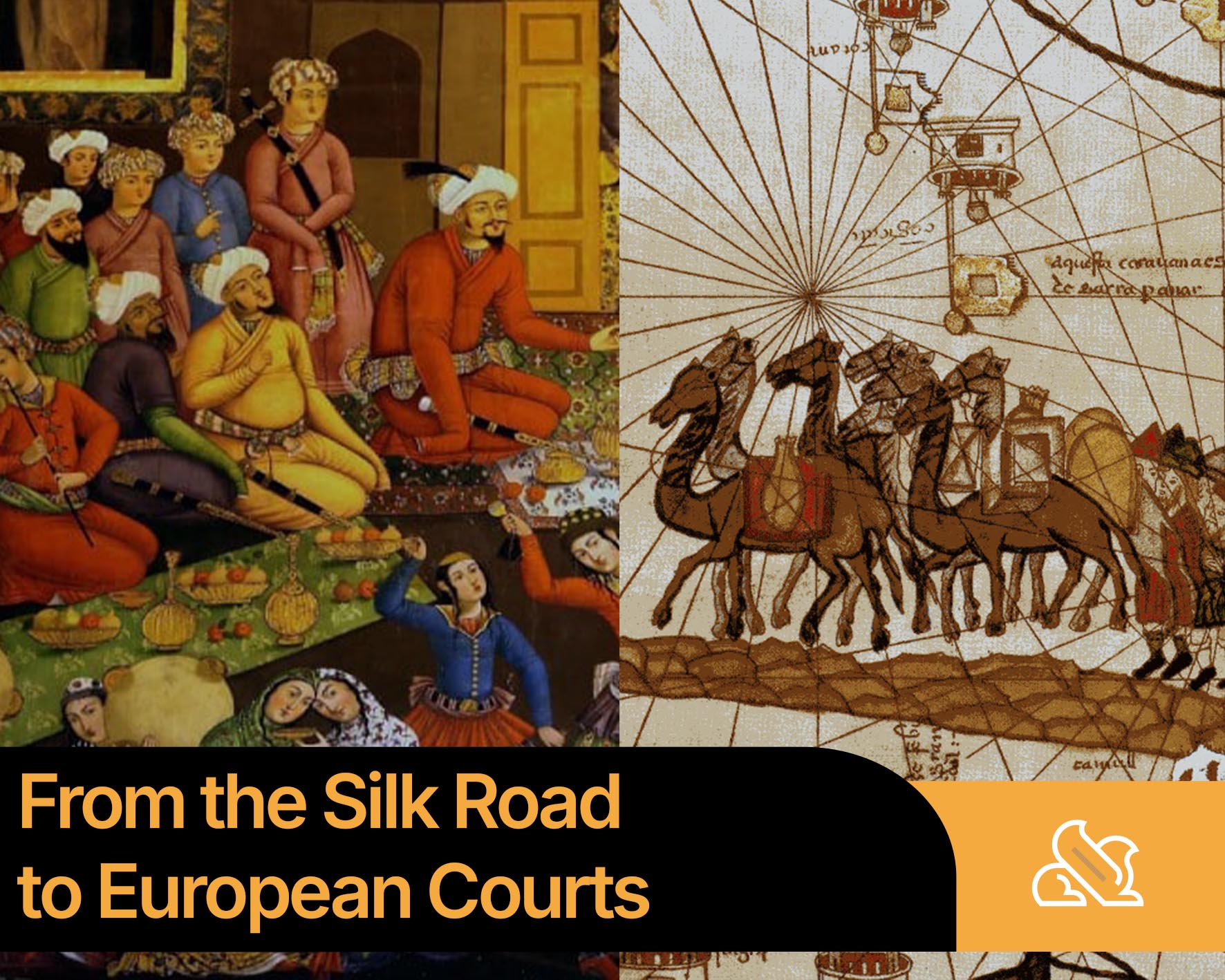
From its golden age in the Sassanian Empire to its refinement under the Safavids, brocade became a signature export on the Silk Road. Caravans carried these luminous textiles from Isfahan, Yazd, and Kashan to the markets of Samarkand, Bukhara, Constantinople, Venice, Florence, and even the treasuries of European churches. Along the way, Iranian motifs such as the boteh (paisley), the Shah Abbasi flower, the Simurgh, and the griffin left indelible marks on the vocabulary of European luxury fabrics.
This article, prepared for Daraniya, explores the journey of Persian brocade from East to West, highlighting its role on the Silk Road, the transformation of Iranian motifs in Europe, and its revival today as a symbol of timeless luxury.
Persian Brocade: Origins and Early Flourishing
Brocade in the Sassanian Era (224–651 CE)
The Sassanian dynasty is often remembered for its grandeur in architecture, religion, and military power—but it was also the age when Persian textiles reached new heights. Archaeological finds and fragments preserved in museums like the Louvre and the Metropolitan Museum of Art show brocades adorned with circular medallions, winged lions, griffins, and pearl roundels. These motifs embodied ideas of kingship, immortality, and divine favor.
Brocades were more than clothing; they were tools of diplomacy. Envoys sent them as tribute to Byzantine emperors, while merchants traded them for precious metals and spices. Each piece was, in essence, a portable manifesto of Persian sovereignty and taste.
Brocade after the Islamic Conquest
The arrival of Islam did not diminish the importance of textiles. Instead, new motifs were added: Quranic calligraphy, geometric arabesques, and stylized floral designs. Cities like Nishapur, Ray, and Yazd became hubs of silk weaving. Persian brocades continued to travel across trade networks, gaining fame as the finest examples of textile art.
The Safavid Renaissance of Brocade
If the Sassanian period was the birth of Persian brocade, the Safavid dynasty (1501–1722) was its golden rebirth. Shah Abbas the Great reorganized Iran’s economy to prioritize luxury crafts, and Isfahan became the beating heart of textile production.
Royal ateliers produced brocades with extraordinary complexity:
- The Shah Abbasi flower motif, a stylized lotus, became the signature of the period.
- Paired birds, cypresses, and vases symbolized paradise and eternal harmony.
- Gold and silver threads gave depth and brilliance, making garments shimmer under candlelight in royal courts.
Safavid brocades were exported widely. Venetian merchants purchased them to sell across Europe, while Ottoman sultans commissioned Persian weavers to produce robes of honor (khil‘at). Today, surviving examples in the Victoria and Albert Museum (London) and the Textile Museum (Washington, D.C.) bear witness to their refinement.
The Silk Road: Pathways of Fabric and Meaning
Trade Routes and Cultural Bridges
The Silk Road was not a single highway but a web of routes. Brocade traveled in two main directions:
- Northern Route: From Isfahan to Mashhad, through Bukhara and Samarkand, across Central Asia to Constantinople. From there, brocades entered the Byzantine court and later Venice.
- Southern Route: From Yazd and Isfahan to the Persian Gulf, then shipped to India. Portuguese and Venetian traders transported them onward to the Mediterranean and Europe.
These routes ensured that Persian brocade became familiar not only in Asia but also across Europe. By the 15th and 16th centuries, Persian fabrics had become staples in aristocratic wardrobes, church treasuries, and merchant inventories.
Beyond Commerce: Carriers of Identity
Unlike many goods, textiles bore visible designs that communicated identity instantly. A motif of a Simurgh, a radiant griffin, or a stylized lotus carried stories of Iranian mythology and cosmology. When such designs appeared on European fabrics, they did not lose their power; instead, they transformed into hybrid languages of art.
Iranian Motifs and Their Transformation in Europe
The Boteh (Paisley)
Perhaps the most famous motif to cross into Europe is the boteh, a teardrop-shaped design symbolizing eternity and regeneration. Through trade with Kashmir shawl weavers, the motif reached Scotland in the 18th century, where the town of Paisley reproduced it on an industrial scale. From Persian symbol to global pattern, the boteh is a testament to Iran’s enduring influence.
The Shah Abbasi Flower and Floral Symmetry
The Safavid lotus motif inspired European damasks and lampas weaves. Italian weavers in Venice and Florence incorporated repeating floral units into silk designs that decorated the gowns of Renaissance aristocracy.
Mythological Figures: The Simurgh and Griffin
The griffin, half-lion and half-eagle, was an emblem of ascension in pre-Islamic Iran. By the medieval period, similar creatures appeared in European heraldry and illuminated manuscripts, often carrying connotations of guardianship and divine authority. This crossover highlights the symbolic dialogue between East and West.
Ecclesiastical Textiles
Persian brocades found their way into church treasuries. Priestly vestments and altar cloths in medieval Europe often used fabrics either imported from Iran or modeled after them. The shimmering presence of gold threads enhanced their sacred aura, blending Persian artistry with Christian ritual.
A Dialogue of Influence: East and West
Cultural exchange was never one-directional. As brocades reached Europe, European designs and palettes began to flow back to Iran. Renaissance floral bouquets, baroque swirls, and even European color trends (like deep crimson or cobalt blue) found their way into Persian workshops. This mutual influence created hybrid aesthetics that reflected the interconnectedness of the early modern world.
Decline and Dormancy
By the 18th and 19th centuries, mechanized weaving in Europe undercut the economic viability of handwoven brocade. European markets favored mass production, and Persian workshops gradually closed. During the Pahlavi period, only a handful of master weavers remained, and the art of Zarbaft was nearly forgotten.
Persian Brocade in the Contemporary World
Revival of a Forgotten Art
The 21st century has witnessed renewed interest in brocade. Scholars, museums, and designers recognize its potential not only as cultural heritage but as a living luxury material.
Daraniya, founded with the vision of reviving Zarbaft, embraces this dual role: preservation and innovation. By working with artisans and promoting the fabric internationally, Daraniya ensures that brocade once again finds a place in global luxury markets.
New Silk Roads: Exhibitions and Digital Platforms
Where caravans once carried brocade, today fashion fairs and digital networks take on the role. Events like Première Vision Paris, Milano Unica, and Heimtextil Frankfurt offer Daraniya opportunities to showcase brocade to haute couture houses and interior designers. At the same time, digital storytelling on platforms like LinkedIn and Instagram builds bridges to audiences worldwide.
Brocade for Haute Couture and Beyond
In a world saturated with synthetic fabrics, brocade stands out as authentic, rare, and meaningful. For haute couture houses, brocade offers more than material—it offers narrative depth. Every motif, every metallic shimmer, tells a story of Iranian resilience, creativity, and cultural dialogue.
Conclusion
The journey of Persian brocade from Sassanian palaces to European cathedrals, from Safavid workshops to modern fashion runways, is a story of cultural endurance and transformation. The motifs of Iran—boteh, Shah Abbasi flowers, Simurghs, and griffins—continue to live on in the language of luxury textiles across the globe.
Daraniya’s mission, rooted in the belief that “Every line has a legacy,” brings this journey full circle. By reviving Zarbaft for today’s luxury world, Daraniya not only preserves heritage but also shapes the future of global textile design.
Persian brocade is not just fabric. It is the golden language of Iranian culture, woven across centuries, still shimmering, still speaking, still inspiring.


